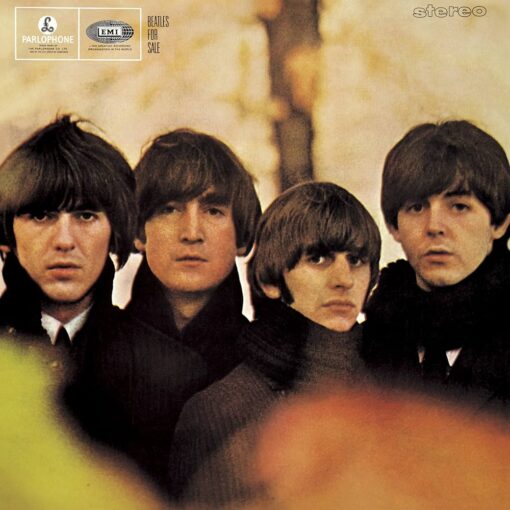
Beatles For Sale

1. No Reply (Lennon/McCartney)
2. I’m a Loser (Lennon/McCartney)
3. Baby’s in Black (Lennon/McCartney)
4. Rock and Roll Music (Chuck Berry)
5. I’ll Follow the Sun (Lennon/McCartney)
6. Mr. Moonlight (Roy Lee Johnson)
7. Kansas City/Hey, Hey, Hey (Leiber/Stoller/Penniman)
8. Eight Days a Week (Lennon/McCartney)
9. Words of Love (Buddy Holly)
10. Honey Don’t (Carl Perkins)
11. Every Little Thing (Lennon/McCartney)
12. I Don’t Want to Spoil the Party (Lennon/McCartney)
13. What You’re Doing (Lennon/McCartney)
14. Everybody’s Trying to be My Baby (Carl Perkins)

Beatles for Sale is The Beatles’ fourth album, released in late 1964 and produced by George Martin for Parlophone, released on mono (catalogue number PMC 1240) and stereo (PCS 3062). The album marked a minor turning point in the evolution of Lennon and McCartney as lyricists, Lennon particularly now showing interest in composing songs of a more autobiographical nature. "I’m a Loser" shows Lennon for the first time seemingly coming under the influence of Bob Dylan having met him for the first time in New York while on tour on 28 August 1964.

Overview

Only six days separate the last full band session for A Hard Day’s Night (Tuesday 2 June) and the first for Beatles for Sale. Prior to the new recording sessions, the band toured Australia and New Zealand (after a two-show night in Hong Kong), played concerts in the Netherlands, Denmark and Sweden and made several television, radio and live concert appearances in the UK. It was "inevitable that the constant grind of touring, writing, promoting, and recording would grate on The Beatles" (Allmusic), leading to the inclusion of several cover versions after the all-original A Hard Day’s Night; the band’s visible weariness on the album’s cover is noted by narrator Malcolm McDowell during The Compleat Beatles. Yet during these sessions they were still capable of recording the single "I Feel Fine" and its B-side, "She’s a Woman" (both not on this album), both songs of considerable quality and interest. There is a strong country influence on songs like "I Don’t Want to Spoil the Party" and "I’m a Loser". Gram Parsons has noted The Beatles strong country influence on "I Don’t Want to Spoil the Party" noting that country rock was popularized in 1967. Musically, there is a strong folk influence "I’m a Loser"’s also notable for being perhaps the first Beatles song to directly reflect the influence of Bob Dylan, thus nudging folk and rock a little closer together toward the folk-rock explosion of the following year.

Background

When Beatles for Sale was being recorded, Beatlemania was just past its peak; in early 1964, The Beatles had made waves with their television appearances in the United States, sparking unprecedented demand for their records. Beatles for Sale was The Beatles’ fourth album in 21 months. Recording for the album began on 11 August, just one month after the release of A Hard Day’s Night, following on the heels of several tours. Much of the production on the album was done on "off days" from performances in the UK, and most of the songwriting was done in the studio itself.
Most of the album’s recording sessions were completed in a three-week period beginning on 29 September. The Beatles’ producer George Martin recalled: "They were rather war-weary during Beatles for Sale. One must remember that they’d been battered like mad throughout ‘64, and much of ‘63. Success is a wonderful thing, but it is very, very tiring."

Song selection

Even the prolific Lennon/McCartney songwriting team could not keep up with the demand for their songs, and with a targeted deadline of Christmas to meet, the band resorted to recording several cover versions for the album. This had been their mode of operation for their first albums but had been abandoned for the all-original A Hard Day’s Night. The album included six covers, the same number as their first two albums. McCartney recalled: "Recording Beatles for Sale didn’t take long. Basically it was our stage show, with some new songs." Indeed, three of the cover tunes were recorded in a total of five takes in one session on 18 October.

Beatles for Sale featured eight original Lennon and McCartney works. At this stage in their collaboration, Lennon’s and McCartney’s songwriting was highly collaborative; even when songs had a primary author the other would often contribute key parts, as with "No Reply" where McCartney provided a middle-eight for what was otherwise almost entirely a Lennon song.
In 1994, McCartney described the songwriting process he and Lennon went through: “ We would normally be rung a couple of weeks before the recording session and they’d say, ‘We’re recording in a month’s time and you’ve got a week off before the recordings to write some stuff.’ …so I’d go out to John’s every day for the week, and the rest of the time was just time off. We always wrote a song a day, whatever happened we always wrote a song a day…. Mostly it was me getting out of London, to John’s rather nice, comfortable Weybridge house near the golf course…. So John and I would sit down, and by then it might be one or two o’clock, and by four or five o’clock we’d be done. ”

Abbey Road Studios

The recording of Beatles for Sale took place at Abbey Road Studios in London. The Beatles had to share the studio with classical musicians, as McCartney would relate in 1988: "These days you go to a recording studio and you tend to see other groups, other musicians… you’d see classical sessions going on in ‘number one.’ We were always asked to turn down because a classical piano was being recorded in ‘number one’ and they could hear us." George Harrison recalled that the band was becoming more sophisticated about recording techniques: "Our records were progressing. We’d started out like anyone spending their first time in a studio — nervous and naive and looking for success. By this time we’d had loads of hits and were becoming more relaxed with ourselves, and more comfortable in the studio… we were beginning to do a little overdubbing, too, probably to a four-track."

Recording was completed on 18 October. The band participated in several mixing and editing sessions before completing the project on 4 November; the album was rushed into production and released exactly a month later. The Beatles’ road manager Neil Aspinall later reflected: "No band today would come off a long US tour at the end of September, go into the studio and start a new album, still writing songs, and then go on a UK tour, finish the album in five weeks, still touring, and have the album out in time for Christmas. But that’s what the Beatles did at the end of 1964. A lot of it was down to naivety, thinking that this was the way things were done. If the record company needs another album, you go and make one."

[From Wikipedia - Original page is here]